
Welcome to the world of the RACI chart, the ultimate blueprint for operational clarity. In this guide, we strip away the jargon to show you how four simple letters can transform a room full of confusion into a synchronized, high-performance team. Whether you’re leading a lean manufacturing floor or a digital transformation, read on to discover how to master the RACI matrix and how to use KPI Fire to make accountability happen automatically.
What is a RACI Chart?
Ever been on a project where everyone thought someone else was doing it, or worse, everyone tried to do the same thing? That’s project chaos, and it’s a productivity killer. Bringing order to that chaos requires more than just a Standard Operating Procedure; it requires a RACI chart.
RACI stands for:
-
Responsible: The person who does the work.
-
Accountable: The “owner” who has “yes/no” authority. There should only be ONE Accountable person per task.
-
Consulted: People whose opinions are sought (two-way communication).
-
Informed: People kept up-to-date (one-way communication).
A RACI chart is a matrix that maps tasks against team members. It is a foundational tool for ensuring your Continous Improvement efforts don’t stall due to lack of ownership.
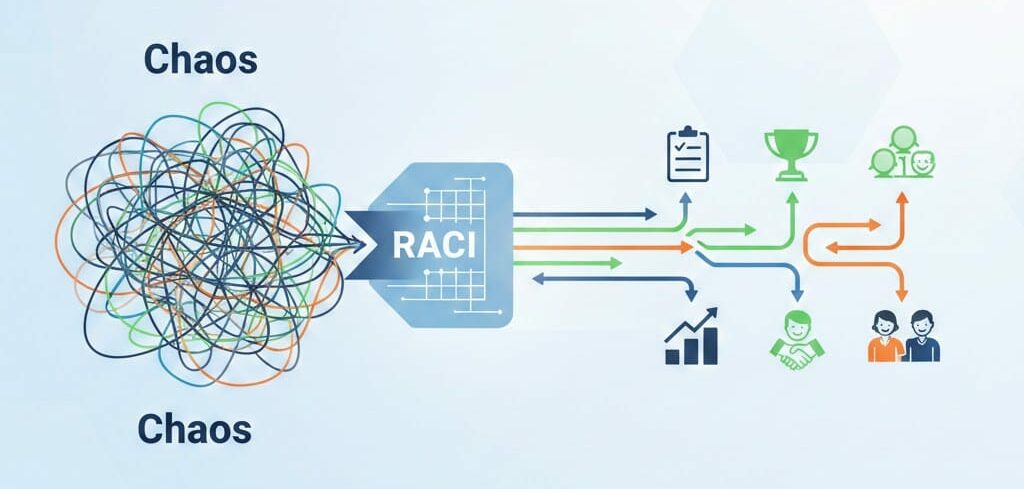
The Problem RACI Solves: Blurred Lines & Bottlenecks
Without a clear understanding of roles, even the most promising Lean Six Sigma initiatives can face:
-
Duplication of Effort: Multiple people doing the same task, wasting resources.
-
Decision Bottlenecks: No one knows who has the final say, delaying progress.
-
Communication Fatigue: Too many people in every meeting, or critical stakeholders being left out.
RACI cuts through this noise by forcing explicit conversations about engagement before work begins. By clarifying these roles, you ensure your Strategic Planning translates into actual execution.
When to Use a RACI Chart (It’s Not Just for Big Projects!)
While often associated with massive enterprise shifts, RACI charts are incredibly versatile. Consider using RACI when:
-
Launching a New Project: Define roles from the start to avoid confusion.
-
Addressing Recurring Bottlenecks: If a process often gets stuck, a RACI can highlight missing accountabilities.
-
Managing Cross-Functional Teams: Essential when departments need to collaborate without stepping on toes.
-
Improving Business Processes: Use RACI to streamline handoffs during Value Stream Mapping.
Best Practices for Building an Effective RACI
Creating a RACI chart isn’t just about filling in boxes; it’s about facilitating the Respect for People that drives a healthy culture.
-
One “A” per Task: If there’s more than one, no one is truly accountable.
-
Minimize “C” and “I”: Only include those who genuinely need to be involved. Too many “C”s lead to “analysis paralysis.”
-
Review and Iterate: Present the draft RACI to the team. This collaborative review unearths unspoken assumptions.
-
Keep it Dynamic: A RACI shouldn’t be a static spreadsheet that gathers digital dust. It should evolve as the project moves through its Project Management lifecycle.
Using KPI Fire to Embed RACI in CI Projects
While spreadsheets are fine for planning, KPI Fire brings your RACI to life by integrating it directly into your daily workflow. Here’s how:
-
Project Level Accountability: In KPI Fire, every Project or Idea has a clearly defined Owner. This automatically identifies the Accountable (A) person for the overall deliverable.
-
Task-Level Responsibility: Break projects into sub-tasks and assign an “Owner” to each. This person is the Responsible (R) party, ensuring the “doing” is never in question.
-
Real-Time Communication (C & I):
-
Followers: Add stakeholders as “Followers” to a project. They are automatically Informed (I) of progress via notifications.
-
Mentions: Use
@mentionsin the comment section to seek input from those who need to be Consulted (C).
-
-
Visual Alignment: KPI Fire allows you to visualize your Hoshin Kanri strategy and see exactly which team members are responsible for the tasks that drive your top-level KPIs.
By leveraging KPI Fire, your RACI moves from a static document to a living engine of team accountability. Schedule a demo today and see how easy it is to move your RACI chart from a static spreadsheet to a high-velocity execution engine.