
The problem usually isn’t a lack of ideas—it’s an abundance of them. Most organizations suffer from “initiative overload,” where dozens of projects are launched simultaneously, but very few actually reach the finish line with meaningful results.
If your project pipeline looks like a cluttered junk drawer of “good ideas,” you need a filter. Enter the Pareto Principle, also known as the 80/20 Rule. When applied to strategic project management, this principle allows you to identify the vital few projects that will deliver the most significant impact on your Key Performance Indicators (KPIs).
In this guide, we’ll explore how to use the Pareto Principle to ruthlessly prioritize your pipeline and how KPI Fire provides the framework to turn these insights into executed strategy.
1. Understanding the 80/20 Rule in Project Management
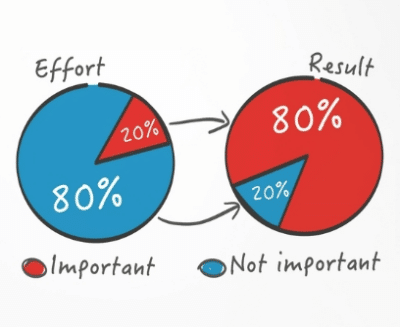
The Pareto Principle states that for many outcomes, roughly 80% of consequences come from 20% of causes. In a business context, this often translates to:
-
80% of your revenue comes from 20% of your customers.
-
80% of your production delays come from 20% of your process bottlenecks.
-
80% of your strategic growth will come from 20% of your projects.
Most managers fall into the trap of treating every project as a “Priority 1.” When everything is a priority, nothing is. By acknowledging the Pareto Principle, you accept that most of the items in your pipeline are “the trivial many”—tasks that consume time and resources but don’t move the needle on your annual goals. Your mission is to find the “vital few.”
Why Projects Fail Without Pareto
Without this lens, teams experience resource dilution. You have 10 engineers working on 50 different tasks. Each task moves forward at a snail’s pace. By the time a project is finished, the market may have shifted, or the problem it was meant to solve has evolved. Using Pareto allows you to concentrate your “force” (your team’s time and budget) on the projects that yield the highest ROI.
2. Step-by-Step: Analyzing Your Pipeline for Impact
To prioritize effectively, you must first gather your data. You cannot apply Pareto logic to a pipeline that isn’t documented.
Step A: Inventory Your Projects
List every active and proposed project. In many companies, this “shadow pipeline” is hidden in Excel sheets, sticky notes, and email threads. This is where you ideally need a single source of truth where every project idea is captured in one central database.
Step B: Assign Value Metrics
You cannot determine the “top 20%” if you don’t know what “value” looks like. Assign a potential impact score to each project based on:
-
Revenue Growth
-
Cost Savings
-
Customer Satisfaction (NPS)
-
Strategic Alignment (Does it actually help achieve an annual goal?)
Step C: The Pareto Analysis
Create a Pareto Chart by plotting your projects on the X-axis and their cumulative projected impact on the Y-axis. You will likely see a steep curve where the first handful of projects account for the vast majority of the total potential benefit. These are your “Non-Negotiables.”
3. The “Vital Few” vs. the “Trivial Many”: How to Cut the Noise
 Once you’ve identified your top 20%, what do you do with the remaining 80%? This is the hardest part of leadership: saying “not now.”
Categories of Categorization
-
The Vital Few (Top 20%): High impact, manageable effort. These receive full funding and the best talent.
-
The Quick Wins: Low effort, moderate impact. These can be “sprinkled in” but should not distract from the vital few.
-
The Trivial Many: High effort, low impact. These projects are “zombies”—they eat resources but offer no life to the company. Kill or archive these immediately.
The Danger of “Pet Projects”
Often, the 80% of low-impact projects are someone’s “pet project.” Using the Pareto Principle provides an objective, data-driven shield. It shifts the conversation from “I don’t like your idea” to “This idea doesn’t fall into the 20% of projects that will hit our $10M savings goal this year.”
KPI Fire Tip: Use the Idea Funnel in KPI Fire to vet these projects before they ever enter your active pipeline. By requiring a “Benefit” estimate during the idea stage, the software automatically helps you spot the 80/20 distribution.
4. Aligning Your Pipeline with Strategic Goals (KPIs)
Prioritization is useless if it’s decoupled from your strategy. A project might have a high ROI, but if it doesn’t align with your Must-Get-Results (MGRs), it’s still a distraction.
The Hoshin Kanri Connection
Many high-performing organizations use Hoshin Kanri (Strategy Deployment) alongside Pareto. You start with your top-level KPIs (e.g., “Reduce defects by 15%”).
-
Identify the Gap: Where are we now vs. where we need to be?
-
Pareto the Root Causes: 80% of those defects are likely caused by 20% of the machines or processes.
-
Select Projects: Only approve projects that directly address that 20% of root causes.
Visualizing the Link
In KPI Fire, you can visually link a project to a specific goal. If a project in your pipeline doesn’t “nest” under a strategic objective, it’s a red flag. This ensures that your 20% of “Vital” projects are the ones that actually drive your company’s specific KPIs.
5. How KPI Fire Automates and Visualizes Pareto Prioritization
Traditional project management tools are just lists of tasks. KPI Fire is designed specifically for Continuous Improvement (CI) leaders who need to manage by impact.
Real-Time Impact Dashboards
Instead of manually creating Pareto charts in Excel, KPI Fire aggregates the data from all your active projects. You can see a real-time view of which projects are contributing the most to your goals.
Resource Management
One of the biggest hurdles to Pareto-based management is resource overallocation. KPI Fire allows you to see if your “A-Players” are stuck working on the “Trivial Many.” You can then reassign them to the “Vital Few” with a few clicks.
Standardizing the Workflow
KPI Fire provides templates for Lean, Six Sigma, and Kaizen projects. By standardizing how projects are executed, you reduce the “effort” side of the 80/20 equation, potentially moving more projects into the high-impact/low-effort quadrant.
Benefits Tracking (The “Hard” Numbers)
At the end of the day, Pareto is about results. KPI Fire tracks the actual dollars saved or earned vs. the original estimate. This creates a feedback loop: you get better at identifying the 20% because you have historical data on what actually worked.
Here’s how the Pareto feature works in KPI Fire:
- Create a Pareto chart: Select the data you want to analyze and create a Pareto chart.
- Identify the most significant factors: The chart will visually represent the frequency of occurrence of different factors, allowing you to easily identify the most significant contributors.
- Prioritize your efforts: Focus your improvement efforts on the factors that have the greatest impact.
By using the Pareto feature in KPI Fire, you can:
- Identify root causes: Determine the underlying causes of problems or issues.
- Prioritize improvement efforts: Focus on the most impactful areas for maximum results.
- Optimize resource allocation: Allocate resources to the areas that will have the greatest impact.
- Drive continuous improvement: Use the Pareto principle to guide your improvement initiatives and achieve long-term success.
Stop Managing Tasks, Start Driving Outcomes
The Pareto Principle is more than just a mathematical observation; it is a discipline of leadership. In the high-stakes environment of operational excellence, your success isn’t measured by how many projects you launch, but by the weight of the results you deliver. By ruthlessly narrowing your focus to the “Vital Few,” teams are liberated from the burnout of the “Trivial Many” and create a culture of high-impact execution.
When you align the 80/20 rule with a powerful strategy deployment tool like KPI Fire, you bridge the gap between “having a plan” and “getting results.” You gain the visibility to see which projects are truly moving your KPIs and the agility to pivot when resources are being wasted on low-value tasks.
Don’t let your strategic goals get buried under a mountain of mediocre initiatives. Take control of your pipeline, empower your people to work on what matters most, and watch your organizational performance reach new heights.
Are you ready to see how KPI Fire can transform your project prioritization and help you execute your 20% with precision? Click here to Request a Demo of KPI Fire today.