
Are you managing what people do—or what the business actually achieves?
Every organization has work happening all the time. Teams hold meetings, complete projects, train employees, improve processes, review reports, and work through action items. On the surface, all of this activity looks like progress. But activity and progress aren’t necessarily the same thing.
Have you heard the popular business advice that leaders should always “manage by results”? Many management experts advocate focusing almost exclusively on outcomes, targets, and lagging KPIs. This advice often implies that managing the means—the day-to-day processes, behaviors, and inputs—is somehow less important than managing the destination.
On the flip side, true continuous improvement organizations—most notably Toyota—take the exact opposite approach. In world-class Lean cultures, leaders care deeply about the means of getting results. To them, building and scaling the system of improvement is vastly more important than hitting any single, isolated target.
As the saying goes: Results are Goals, but Means are Systems. And Systems are greater than Goals.
So, how do we reconcile Management by Means (MBM) and Management by Results (MBR) without falling into the trap of managing vanity metrics or chasing isolated targets?
Defining MBR vs. MBM
To understand how both frameworks work together, let’s establish clear definitions:
- Management by Results (MBR) focuses on the outputs and outcomes an organization needs to achieve. It establishes the destination, answering questions like: Did we increase revenue? Did we reduce cycle time? Did we cut defects by 15%?
- Management by Means (MBM) focuses on the inputs, methods, daily habits, and standard operating procedures used to get work done. It establishes the pathway, answering questions like: Did we conduct our daily huddle? Did we follow the SOP? Did we perform our Gemba walks and execute our improvement projects?
Why Toyota Focuses on the Means: Systems Over Goals
In many Western organizations, hitting the goal is celebrated regardless of how it was accomplished. If a plant meets its quarterly shipping quota by pushing workers into forced overtime, bypassing quality checks, or running equipment to the brink of failure, the result is still logged as a “success.”
In the Toyota Production System (TPS), this approach is recognized for what it is: dangerous and unsustainable.
Toyota prioritizes the means because a goal is merely a temporary milestone, whereas a system is the engine that produces infinite future outcomes.
1. Goals Don’t Scale; Systems Do
Achieving a single result through heroics or brute force cannot be replicated across ten factories or a hundred teams. A standardized, disciplined method for solving problems (like A3 thinking or Kata), on the other hand, can be scaled across an entire global enterprise.
2. Standardized Processes Create Predictability
When you manage solely by results, outcomes become unpredictable. If you don’t control and standardize the means, you cannot identify what caused a success or a failure. In Lean philosophy, “where there is no standard, there can be no improvement.”
3. Sustainable Capabilities Outlast Targets
Hitting a quarterly target gives you one good quarter. Teaching your workforce a standardized continuous improvement system gives your organization the long-term capability to adapt to any market shift, crisis, or operational challenge for decades to come.
What Is Management by Means?
Management by Means focuses on the activities, methods, processes, and inputs used to achieve an objective. These measures are useful because they tell managers whether key activities are happening and whether teams are following the processes intended to drive improvement.
Examples of Managing by Means:
- Conducting a Gemba walk on the shop floor
- Running a daily huddle or shift stand-up
- Adhering strictly to Standard Operating Procedures (SOPs)
- Executing Leader Standard Work routines
- Capturing employee improvement ideas through Idea Management software
- Running Kaizen events or Lean Six Sigma projects
For example, an organization might track the number of employees trained, improvement projects launched, customer calls completed, audits performed, action items closed, or Lean events conducted. These can all provide valuable information, particularly when they are used as leading indicators of future performance.
The Dangers of Ritual Without Vision
The problem begins when completing the activity becomes a mindless ritual detached from learning:
- Ritual Over Value: Teams can blindly check boxes on an audit sheet or host daily huddles simply because “it’s the rule,” completely losing sight of the underlying capability the ritual was meant to build.
- Activity ≠ Achievement: A team can complete 20 improvement projects and still fail to improve the KPI that matters if the projects were poorly targeted or disconnected from root causes.
- Vanity Progress: Being busy is not the same as being effective. Running the engine at high RPMs doesn’t matter if the transmission isn’t engaged with the wheels.
What Is Management by Results?
Management by Results starts with a different question: What outcome are we trying to achieve, and how will we know whether we’ve achieved it?
Instead of focusing primarily on the amount of work completed, Management by Results looks at measurable changes in business performance. That might mean reducing costs, improving quality, shortening cycle time, increasing customer satisfaction, improving on-time delivery, reducing defects, increasing throughput, or making measurable progress toward a strategic objective.
This is where KPI management dashboards become essential. A well-designed KPI provides the target that tests whether your system is actually working.
Where MBR Works Well
MBR excels at creating alignment, clarity, and urgency. It gives teams a concrete goal to rally around—often captured in SMART goals (Specific, Measurable, Achievable, Relevant, Time-bound)—and provides clear visibility into whether the business is moving the needle.
The Dangers of Over-Focusing on Results
When MBR is applied in isolation without an understanding of how work gets done, major operational issues arise:
- Unpredictable and Unscalable Gains: If a team hits a target through brute force or heroic one-off efforts, the result is rarely reproducible or scalable. You achieved the result, but you don’t actually know why.
- Short-Term Compromises: An excessive focus on end-of-quarter numbers can incentivize teams to take shortcuts on quality, safety, or process integrity just to “hit the number.”
- The Trap of Goodhart’s Law: When a lagging measure becomes the target, people begin optimizing the metric itself rather than improving the underlying business reality. The KPI goes up, but the business doesn’t actually get better.
Means vs. Results: What’s the Difference?
The distinction becomes clearer when you put the two approaches side by side:
| Question/Perspective | MBM | MBR |
|---|---|---|
| Philosophical Core | Systems Focus: How we do things | Goal Focus: What we achieve |
| Primary Value | Scalable, repeatable capability | Concrete milestone / destination |
| Activity vs. Impact | Did we follow and refine the system? | Did the activity move the metric? |
| Project Tracking | Are we building problem-solving skills? | What short-term savings did we log? |
| Goal Alignment | Are our daily habits disciplined? | Did we hit our quarterly target? |
| Long-Term Risk | Danger of mindless ritualism | Danger of shortcuts, burnout, and unscalable gains |
The crucial point is that means build the engine, while results measure the speed. A strong management system needs visibility into both.
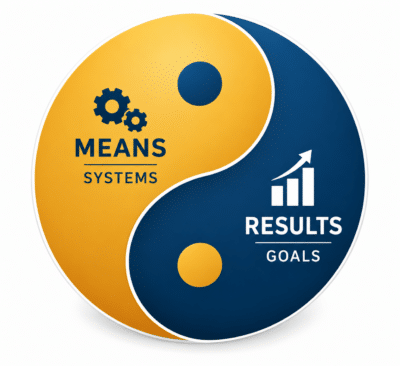
Management by Means and Management by Results are complementary approaches. Sustainable improvement requires both disciplined systems and measurable outcomes.
Connecting Means to Results: Cause, Effect, and Y=f(x)
Neither approach works in isolation. The power of world-class operational strategy lies in connecting MBM (Systems) to MBR (Goals) through core process improvement principles.
In Six Sigma and Lean frameworks, this cause-and-effect relationship is expressed mathematically through the concept of Y=f(x):
Y=f(x)
Where:
- Y (The Result / Lag Measure): The outcome or goal you care about (e.g., On-Time Delivery, Profitability, Customer Retention).
- x (The Means / Lead Measures / System): The inputs, process steps, standard behaviors, and controllable activities that drive Y.
If you want to change Y, you don’t stare at Y or demand that Y improve. You change the x’s—the systems and means that generate Y.
The Feedback Loop & The Importance of Human Judgment
What happens when a KPI misses its target even after you manage the means perfectly—following every step of your SOP and executing your standard work?
When managing the means doesn’t produce the expected result, it isn’t a failure—it is a vital feedback loop.
In an effective continuous improvement ecosystem, activity-based leading indicators are treated as hypotheses. When you execute x flawlessly and Y fails to change, strong lead-lag analysis tells you that your hypothesis was incorrect and your process understanding needs refinement.
This is where human judgment becomes indispensable. Dashboards and data provide visibility, but leaders must bring the critical thinking required to interpret the feedback loop. Rather than blaming the team for missing the target or blindly demanding more effort, skilled leaders look at the gap between system execution and results to ask:
- What did we expect to happen?
- What actually happened?
- Did we address the wrong root cause?
- How must our system and execution adapt?
Five Ways to Shift Toward a Systems-First Culture
You don’t need to transform your entire management system overnight. A few deliberate changes can start shifting the conversation from short-term targets to long-term capability:
1. Evaluate the “How,” Not Just the “What”
In performance reviews and project debriefs, don’t just ask if the target was met. Ask: How was the result achieved? Is the new process standardized, repeatable, and scalable?
2. Give Every Major Project a KPI
Ask one simple question before approving any improvement project: Which KPI should this system change improve? Connecting performance metrics to system improvement makes the purpose of the work crystal clear.
3. Track Benefits, Not Just Completion
Don’t let “100% complete” become the finish line. Leveraging Idea Funnels helps organizations capture frontline improvement opportunities, turn them into structured projects, and verify long-term benefits.
4. Treat Missed Targets as Learning Opportunities
When a metric goes red despite full compliance with standard work, celebrate the discovery. It means your system just handed you the exact data needed to make your process even stronger.
5. Give Employees Line of Sight
People engage deeply with continuous improvement when they see how their daily habits and standard work directly influence higher-level company goals.
What KPI Fireside Says About Results
The relationship between improvement activity, measurement, and business impact is a recurring theme on the KPI Fireside Podcast.
In KPI Fireside Episode 74, guest David Norris discussed building a culture of improvement and demonstrating measurable value from continuous improvement initiatives. His key takeaway aligns directly with managing by results:
“You have to show the data. You have to show that ROI on why you’re doing it.”
Showing the data isn’t about bragging about a single win—it’s about proving that your continuous improvement system is working as designed and producing repeatable value.
The Ultimate Test: So What Changed?
At the end of every project, initiative, and strategic review, ask one deceptively simple question: So what changed in our system?
Did our processes become more reliable? Did quality increase? Did cost decrease? Did our team gain a new problem-solving capability?
- If the answer is yes, you’ve built a scalable system.
- If the answer is no, you’ve got information—and that information is where the next iteration of system improvement begins.
Build a Scalable System of Improvement with KPI Fire
If your organization is tracking hundreds of disconnected activities, projects, and KPIs, it’s time to stop chasing short-term targets and start building a unified continuous improvement system.
KPI Fire brings together Hoshin Kanri strategy execution, real-time KPI dashboards, continuous improvement software, and Standard Work routines into a single visual ecosystem.
When strategy, systems, and metrics are connected, teams gain line of sight: everyone can see how daily standard work drives long-term strategic goals, ensuring your gains are repeatable, scalable, and built to last.
👉 Ready to see KPI Fire in action? Schedule a Demo Today