
Most leaders treat Michael Porter’s classic framework as a one-time exercise for a dusty slide deck, but we choose to see it differently. To win, you have to transform strategic theory into daily action. And according to some; if you aren’t using these five market forces to dictate your continuous improvement priorities, profitability is left to chance.
Join us as we reveal how Porter’s Five Forces can identify market pressures and turn them into actionable Continuous Improvement projects. If you’re ready to stop reacting to the market and start shaping it, dive into how you can use the Five Forces to build a more resilient, aligned, and competitive organization.
Introduction and Definition
In 1979, a young Harvard professor named Michael Porter published “How Competitive Forces Shape Strategy,” forever changing the way we look at business. Before Porter, many companies focused narrowly on their direct competitors. Porter argued that competition goes far beyond your immediate rivals; it’s a “corporate ecosystem” of five distinct forces that determine the attractiveness and profitability of an industry.
Understanding this history is vital for achieving strategic alignment. By looking at the external environment through Porter’s lens, you can move away from reactive “firefighting” and toward a proactive strategy execution model that accounts for suppliers, customers, and potential disruptors.
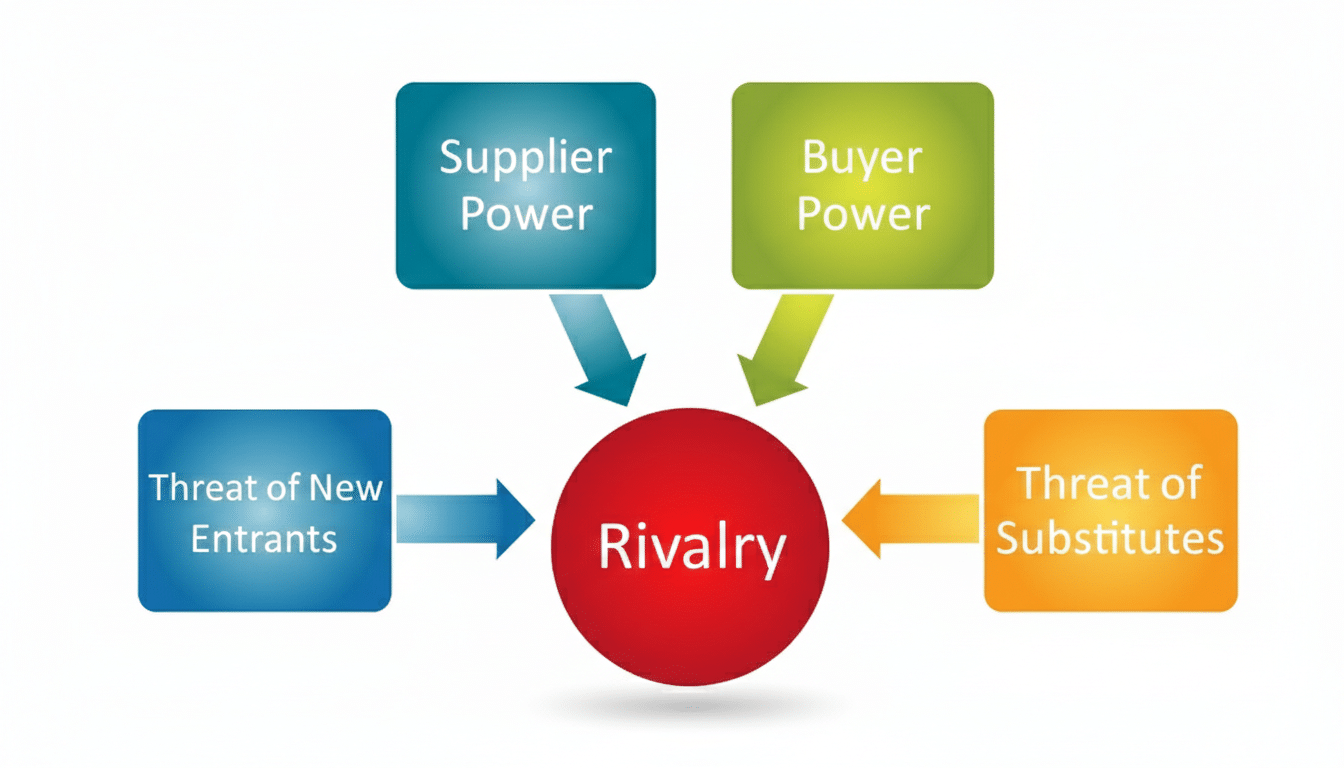
Here is a breakdown of the Five Forces as shown in the model, along with how each one impacts your business strategy:
-
Rivalry Among Existing Competitors: This is the center of the gear system. It measures the intensity of competition in your current market. High rivalry—driven by many competitors or slow industry growth—leads to price wars and necessitates constant operational excellence to maintain margins.
-
Bargaining Power of Suppliers: This force looks at how much leverage your providers have. If there are few suppliers for a critical resource, they can drive up prices and reduce your profitability. Tracking KPIs with a KPI dashboard related to supply chain health is vital here.
-
Bargaining Power of Buyers: When customers have many choices or buy in large volumes, they hold the power to dictate prices. To counter this, businesses must use Standardized Work to ensure a level of quality that customers can’t find elsewhere.
-
Threat of New Entrants: This evaluates how easy (or hard) it is for new players to enter your market. High barriers to entry, such as high capital costs or proprietary technology, protect your market share. Using Hoshin Kanri helps you build these long-term competitive advantages.
-
Threat of Substitutes: This is the risk of customers finding a different way to do what you do (e.g., using a smartphone instead of a dedicated camera). Staying ahead of substitutes requires a strong culture of strategy execution and innovation.
1. Mapping Your Competitive Rivalry
The center of the Five Forces is the intensity of your current competition. In a crowded market, simply “working harder” is a losing strategy. To gain a true edge, you must transition from reactive competition to proactive Strategy Execution.
Action Steps:
-
Identify the “Moat”: Determine what your competitors cannot easily replicate (e.g., speed, specialized quality, or cost-efficiency).
-
Launch Differentiation Projects: Use Operational Excellence software to prioritize projects that directly widen the gap between you and your rivals.
-
Audit Your Speed: If your competitors are faster, use Value Stream Mapping and other Lean tools for Continuous Improvement to identify lead-time bottlenecks and eliminate them before your competition does.
2. Mitigating Supplier Power Through Operational Agility
When suppliers hold the cards, your margins are at risk. High bargaining power from suppliers can manifest as sudden price hikes or supply chain bottlenecks that derail your strategic alignment. To neutralize this force, you must treat your supply chain as an extension of your own Lean ecosystem.
Action Steps:
-
Diversify and Standardize: Use Standardized Work to ensure your processes are flexible enough to incorporate alternative materials or vendors without a drop in quality.
-
Collaborative KPIs: Use a KPI management system to track supplier performance in real-time. If a supplier becomes a “single point of failure,” launch a project to source alternatives or re-engineer the product to reduce dependency.
-
Waste Elimination: Apply Lean tools to your procurement process. Reducing the 8 wastes of Lean can often offset the rising costs imposed by powerful suppliers.
3. Neutralizing Buyer Power with Unmatched Value
In a world where the “Bargaining Power of Buyers” is amplified by the internet and global choice, loyalty is earned through consistency. If your customers can easily switch to a competitor, your only defense is to become indispensable through Operational Excellence.
Action Steps:
-
Voice of the Customer (VOC): Make room for the voice of the customer in strategic planning. Integrate customer feedback directly into your Continuous Improvement loop. If buyers are demanding lower prices, identify the “Non-Value-Added” steps in your process that are inflating costs.
-
Quality as a Moat: High buyer power is often negated by superior quality. Be sure to track quality metrics and ensure that every output meets a standard that competitors simply cannot match.
-
Transparency: Use your data to show customers the value you provide, shifting the conversation from “price” to “partnership.”
4. Building Barriers Against New Entrants
The “Threat of New Entrants” is a constant in a fast-moving economy. To protect your territory, you must build “moats” that are too expensive or too complex for startups to cross. This is where the X-Matrix Hoshin Kanri (Policy Deployment) becomes your greatest weapon, allowing you to focus on long-term breakthroughs while others are stuck in the short term.
Action Steps:
-
Scale and Efficiency: Optimize your workflows so deeply that new entrants cannot match your price point or speed without years of experience.
-
Intellectual Property of Process: Document your unique “Way of Working.” When your organizational knowledge is digitized and standardized, it becomes an asset that a newcomer can’t buy off the shelf.
-
Rapid Innovation: The best barrier to entry is a moving target. Use a culture of strategy execution to innovate faster than a startup can iterate.
5. Staying Ahead of Substitutes via Innovation
The “Threat of Substitutes” is often the most dangerous because it comes from outside your industry. To counter this, you cannot just do what you do better; you must be willing to evolve. This requires a Continuous Improvement mindset that isn’t afraid to disrupt its own product line.
Action Steps:
-
Scan the Horizon: Use your monthly business reviews to look for “non-traditional” competitors. If a substitute technology emerges, don’t ignore it—evaluate it as a potential new project.
-
Agile Project Management: When a substitute threatens your market, be sure to pivot your resources quickly. Move your best people from legacy projects to innovation initiatives. Leverage agile strategic project management techniques.
-
Focus on the “Job to be Done”: Remember that customers don’t buy a drill; they buy a hole. Stay focused on the customer’s ultimate goal, and use your Lean tools to find the most efficient way to deliver that result, even if it means changing your core offering.
Strategy is Nothing Without Execution
Michael Porter’s Five Forces provide the map, but KPI Fire provides the engine. Identifying that your suppliers have too much power or that a substitute is encroaching on your territory is only the first half of the battle. The second half—the winning half—is moving those insights off the whiteboard and into your daily workflow.
When you treat the Five Forces as dynamic pressures rather than static academic concepts, you transform your organization from a reactive player into a market leader. By linking these strategic forces directly to your Continuous Improvement projects and tracking them through a centralized KPI dashboard, you ensure that every person in your organization is pulling in the same direction: away from competitive threats and toward industry dominance.
Take the Next Step
Don’t let your competitive analysis gather dust – and don’t let your strategic plan sit in a binder. Start turning those market pressures into measurable wins today. Are you ready to turn your Five Forces analysis into tangible results? . See how KPI Fire helps you align your team, track your goals, and execute your strategy with precision. Request a Demo of KPI Fire today.