
Imagine pumping twice as much fuel into a car that has a clogged fuel line. Does the car go twice as fast? Of course not. It stalls, chokes, or breaks down under pressure. Yet, this is precisely how many organizations approach scaling.
When leadership sets an ambitious growth target—whether it’s doubling revenue or increasing production throughput—the knee-jerk reaction is to flood the organization with more capital, hire more staff, or purchase expensive enterprise systems. The result? Costs explode, employee burnout spikes, and performance stalls.
If an operation breaks under the weight of growth, it isn’t usually due to a lack of effort or talent. It happens because the organization tried to scale past its Theory of Constraints bottleneck without solving it first.
What is the Theory of Constraints?
Popularized by Dr. Eliyahu M. Goldratt in his seminal 1984 business novel The Goal, the Theory of Constraints is a management philosophy built on a simple premise:
Every complex system, no matter how efficient it appears, has at least one single constraint that limits its ability to achieve higher performance relative to its goal.
In continuous improvement terms, your organization operates like a chain. The total strength of that chain is strictly governed by its single weakest link. Strengthening any link other than the weakest one yields zero overall increase in system strength—it merely adds cost and complexity.
As process expert John Hetherington noted during his guest appearance on the KPI Fireside podcast Episode 73:
“A bad process automated is still a bad process. AI and automation will just make a situation worse unless that situation is good. The constraint will move once you solve one—it’s like whack-a-mole—so you have to systematically find and fix the next one.”
Why Ambitious Growth Targets Break Operations
When executive teams set aggressive expansion goals, they often assume that scaling up every department uniformly will produce proportional results. However, operational bottlenecks are non-linear.
When you double throughput targets across an enterprise without finding the bottleneck, three destructive operational traps occur:
1. Phantom Constraints
Teams mistake symptoms for causes. For instance, a manufacturing company experiencing late customer deliveries might assume their Enterprise Resource Planning (ERP) software is outdated and demand a multi-million-dollar replacement. Upon closer inspection, the root issue might simply be that sales representatives lack live visibility into finished goods through integrated KPI tracking software, leading them to promise impossible lead times.
2. Work-in-Process (WIP) Explosion
Pushing more work into a system upstream of a bottleneck doesn’t produce more finished output. It only creates massive piles of uncompleted work, high inventory holding costs, and widespread chaos on the shop floor or in digital queues. Implementing proper WIP limit strategies and huddleboards (visual workflow boards) help balance capacity and prevent system overload.
3. Misguided Automation
When organizations automate processes without identifying their true system constraint, they often end up speeding up the wrong parts of the pipeline. Accelerating steps on either side of a bottleneck doesn’t increase total output—it merely expands idle waiting periods or piles up surplus inventory at a faster rate.
For instance, if a core constraint caps finished production at 40 units per hour, ramping up an earlier step to output 200 units per hour does not generate more finished goods. Instead, it generates an operational pileup. To prevent costly missteps, leaders should deploy targeted continuous improvement frameworks first, ensuring technology investments directly relieve the primary bottleneck before scaling up upstream capacity.
The 5-Step Framework to Eliminate Operational Constraints
To systematically identify and eliminate constraints without wasting capital or burning out teams, continuous improvement leaders rely on the 5 Focusing Steps of TOC, adapted here into an actionable, modern execution model:
Step 1: Identify the Constraint
Locate the specific process step, policy, or resource that limits total system output.
- Manufacturing: Look for the station with the largest pile of work-in-process (WIP) inventory sitting before it. Leveraging real-time KPI management software can make these physical or operational buffers immediately visible across operations.
- Knowledge Work / Service: Look for the department with the longest backlog, highest overtime, or most severe communication delays. Conducting a quick Gemba Walk can help leaders spot these operational friction points on the ground.\
- Sales & Operations: Map out the end-to-end journey using value stream mapping by asking: If we dropped a single order into the system right now, what would prevent it from running from order to delivery without stopping once?
Step 2: Exploit the Constraint
Maximize the performance of the constraint using existing resources. Do not spend money or buy new technology yet. Ensure that the constraint is running at 1 % capacity without unnecessary downtime or processing non-critical tasks.
Employing 5S methodology at the bottleneck area helps eliminate wasted operator time, unnecessary searching, and workplace clutter that slows down output.
Step 3: Subordinate Everything Else to the Constraint
Align the pace of the entire organization to match the output rate of the constraint.
- Stop upstream workstations from overproducing by implementing pull-based Kanban systems or drum-buffer-rope scheduling
- Ensure downstream teams are always ready to receive output from the bottleneck so it never stalls
- Adjust performance metrics so departments are evaluated on overall system flow rather than localized efficiency.
Utilizing a structured Hoshin Kanri strategy deployment process ensures that local team goals strictly align with global operational throughput.
Step 4: Elevate the Constraint
If system capacity is still insufficient after exploiting and subordinating, invest time and resources to expand the constraint’s throughput. This is the stage where you consider hiring additional personnel, buying equipment, or executing focused Kaizen events to re-engineer the process.
Tracking these high-impact projects through lean project management tools ensures that team investments yield measurable ROI before capital is spent.
Step 5: Repeat (Prevent Inertia)
Once the constraint is successfully elevated, it will shift to another location in the business—the classic “whack-a-mole” effect. Go back to Step 1 and repeat the process for the new constraint. Never allow operational inertia to become the system’s final constraint.
Establishing an enterprise-wide culture of continuous improvement keeps teams proactive as bottlenecks shift throughout the business lifecycle.
Actionable Solutions: Eliminating Common Constraints
Depending on your industry, operational bottlenecks usually fall into one of three distinct categories. Here is how to resolve them:
| Constraint Type | Root Cause | Actionable Solution |
|---|---|---|
| Policy Constraint | Outdated approval thresholds, rigid handoffs, or legacy metrics that reward local optimization over system flow. |
Eliminate unnecessary sign-offs. Shift performance metrics from local efficiency to End-to-End Velocity and On-Time In-Full (OTIF) delivery. |
| Capacity Constraint | Over-committed resources, workload imbalance, equipment/staffing bottlenecks, or oversized batching that caps throughput. |
Identify and elevate the bottleneck. Cross-train personnel, reallocate resources, optimize batch sizes, and implement load balancing (Heijunka). |
| Visibility Constraint | Data silos, opaque inventory/ work-in-progress (WIP) status, fragmented tools, or a lack of real-time operational tracking. |
Deploy centralized visual management tools (e.g., Kanban boards, ERP integration), standardize status tracking, and automate value stream reporting. |
Pro Tip: When evaluating process changes, measure outcomes using the 3 Fs:
-
Functionality: Does the change solve the core structural defect?
-
Facts: Are hard metrics (revenue, cycle time, backlog value) improving?
-
Feelings: Does the team feel confident and empowered by the simplified process?
How to Leverage KPI Fire for the Theory of Constraints
Applying the Theory of Constraints on paper or via sticky notes on a whiteboard works well for a single workshop. However, managing enterprise-wide continuous improvement across dozens of sites, hundreds of employees, and evolving strategic goals requires an operational framework that keeps everyone aligned.
This is where KPI Fire bridges the gap between TOC methodology and daily execution.
1. Identify Constraints with Real-Time KPI Dashboards
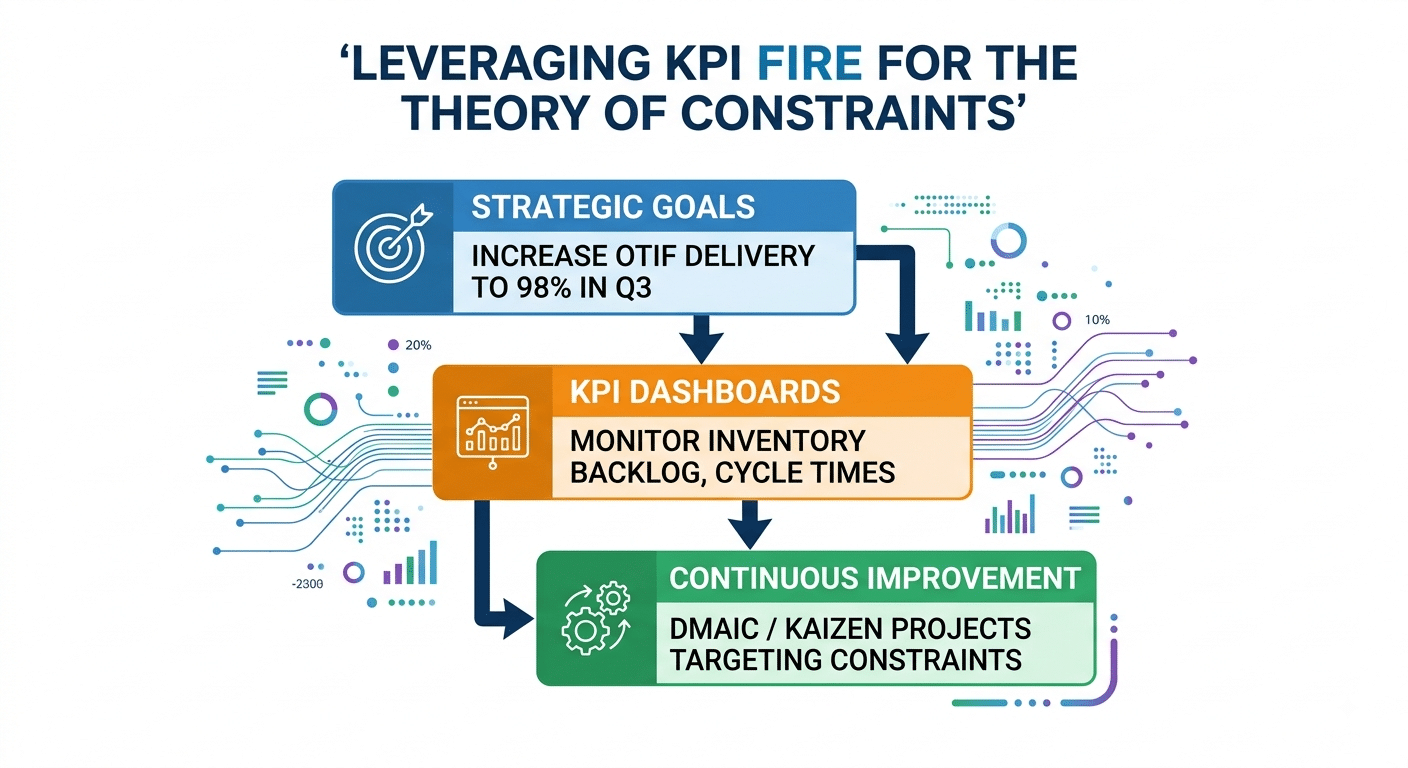
Before you can fix a constraint, you need visibility. KPI Fire’s KPI tracking software allows you to monitor key operational indicators—such as cycle times, inventory backlog, OTIF delivery, and throughput—in centralized dashboards. When a metric trends into the red, your leadership team can instantly pinpoint where the operational flow has stalled without digging through disconnected spreadsheets. You can read more about setting up effective visual controls in our guide on visual management systems.
2. Subordinate Strategy to Actionable Projects
Once a constraint is identified, KPI Fire helps you convert strategy into execution through robust strategy execution management. You can tie specific continuous improvement projects directly to the high-level KPI affected by the bottleneck—whether using Six Sigma DMAIC projects, Lean initiatives, or rapid Kaizen events. This ensures complete alignment and prevents teams from executing “vanity projects” that optimize non-bottleneck steps.
3. Standardize the 5-Step Process Across Teams
KPI Fire provides built-in project templates based on proven continuous improvement frameworks via integrated lean project management tools. You can create standardized workflows for your TOC efforts, guiding teams through:
- Mapping value streams to locate the bottleneck
- Establishing root cause analysis tools like 5 Whys and Fishbone diagrams
- Documenting standard work to prevent the constraint from returning
4. Engage Frontline Workers in Bottleneck Elimination
The people closest to the work are almost always the first to know where the constraint lives. KPI Fire’s idea management software empowers frontline employees to submit ideas for bottleneck elimination directly from their mobile devices. Management can review, approve, and convert those frontline insights into active improvement projects with a single click, driving a true bottom-up continuous improvement culture.
Ready to Remove Operational Bottlenecks?
Don’t let hidden constraints cap your company’s growth potential or break your operations. Alignment between high-level strategy and shop-floor execution is what turns ambitious growth targets into measurable operational results.
Schedule a Demo with KPI Fire Today to see how our continuous improvement platform helps you track metrics, execute projects, and scale your operations without breaking them.