
“The message of the Kaizen strategy is that not a day should go by without some kind of improvement being made somewhere in the company.” — Masaaki Imai
True transformation lives where the philosophy of the mind meets the discipline of the tool. It’s found in the collective energy of a team standing at the Gemba, seeing waste not as a failure, but as an invitation to create value.
But how do you capture that lightning in a bottle? How do you turn a five-day burst of energy into a permanent shift in your bottom line? In this guide, we are opening the doors to the complete Kaizen experience.
What is Kaizen?
Kaizen is a Japanese philosophy that means continuous improvement. It’s not about massive, disruptive changes—it’s about small, consistent steps forward. In business, Kaizen empowers every employee, from frontline workers to executives, to identify inefficiencies and improve processes. Over time, these incremental changes compound into significant performance gains.
Origin and History of Kaizen
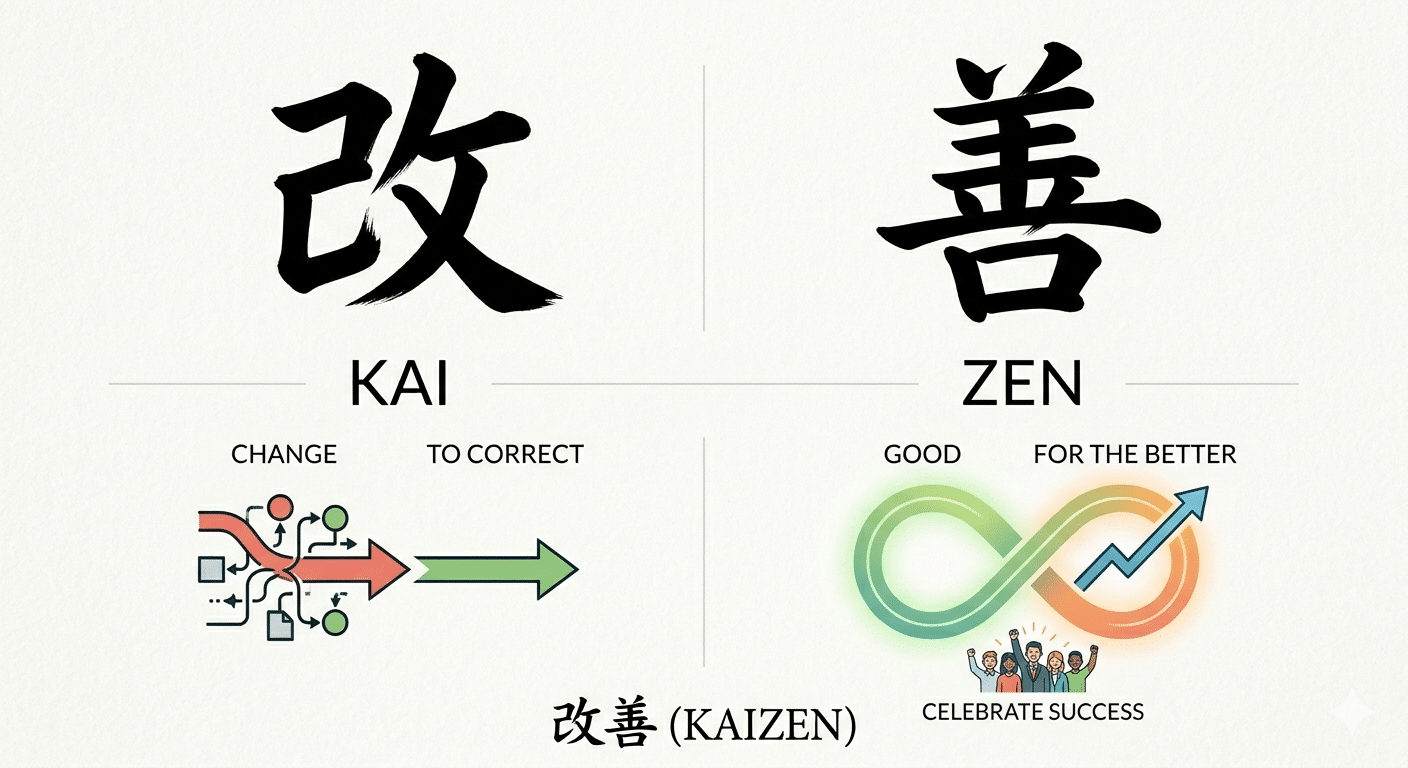
The term Kaizen is written in Japanese using two kanji characters: 改 (kai), meaning “change” or “to correct,” and 善 (zen), meaning “good.” Its roots are deeply embedded in post-World War II Japan, where the concept emerged as part of Japan’s efforts to rebuild its economy. Over time, Kaizen evolved into a comprehensive philosophy emphasizing small, incremental changes that collectively lead to significant improvements.
The formal introduction of Kaizen to the Western world is often credited to Masaaki Imai, who popularized the methodology through his 1986 book “Kaizen: The Key to Japan’s Competitive Success.” Since then, Kaizen has become a cornerstone of lean manufacturing and business excellence worldwide, promoting a culture where every employee, from executives to frontline workers, actively participates in continuous improvement.
Why Kaizen Matters in Business
Organizations that embrace Kaizen build cultures of adaptability and resilience. Instead of waiting for big breakthroughs, they:
- Spot and solve problems quickly
- Reduce waste and inefficiency
- Improve quality and customer satisfaction
- Boost employee engagement by involving everyone in improvement
Kaizen makes improvement a daily habit, not a one-time project.
The Core Principles of Kaizen
Kaizen rests on a few simple but powerful lean principles:
- Continuous Improvement: Always look for ways to get better.
- Employee Involvement: Everyone contributes ideas and solutions.
- Standardization: Document and share best practices.
- Eliminate Waste: Focus on removing inefficiencies.
- Incremental Change: Small steps add up to big results.
These principles ensure that improvement is sustainable and scalable.
Common Tools Used in Kaizen
Several tools support the Kaizen methodology, helping teams identify and implement improvements effectively:
- 5 Whys Analysis: A technique to explore the root cause of problems by asking “Why?” repeatedly. Learn more about root cause analysis here.
- PDCA Cycle (Plan-Do-Check-Act): A four-step iterative process for continuous improvement. Discover the differences between DMAIC and PDCA here.
- Value Stream Mapping: Visualizing the flow of materials and information to identify waste. Explore value stream mapping techniques in our Lean Six Sigma Blog.
- Gemba Walks: Managers observe the actual work process to find improvement opportunities. Read about effective Gemba Walks in our article on Employee Engagement.
- Kaizen Blitz: Intense, short-term improvement events focused on specific areas. Learn how to run Kaizen Blitz events in this blog.
Implementing Kaizen Across Departments
Kaizen can be tailored to fit various departments within an organization, maximizing its impact:
Operations
Focus on streamlining workflows, reducing downtime, and improving quality control. Small adjustments in processes can lead to significant efficiency gains.
Human Resources
Use Kaizen to enhance recruitment processes, employee onboarding, and training programs. Continuous feedback loops help improve employee satisfaction and retention.
Sales and Marketing
Apply Kaizen to optimize customer interactions, refine sales strategies, and improve campaign effectiveness through regular review and adjustment.
IT and Support
Implement Kaizen to improve system reliability, reduce response times, and enhance user experience by continuously addressing issues and updating processes.
Implementing Kaizen Across Industries
While Kaizen originated on the factory floor, its core philosophy of “change for the better” is universal. By empowering every employee to identify and eliminate waste, organizations across all sectors can create a culture of continuous improvement.
Manufacturing: Eliminate Waste
Focus on eliminating the “Eight Wastes” (Muda) to create a lean, high-velocity production floor. Kaizen in this environment centers on optimizing Standardized Work, improving machine uptime through preventative maintenance, and empowering operators to identify bottlenecks in real-time. By refining the physical flow of goods and reducing cycle times, you transform the factory floor into a self-improving execution engine.
Healthcare: Reducing Patient Wait Times
Hospitals often use Kaizen to streamline patient flow in emergency rooms or outpatient clinics. By analyzing the “Value Stream”—the steps from check-in to discharge—staff can identify bottlenecks like redundant paperwork or inefficient room turnover.
Result: A clinic might implement a “Visual Management” system (like a digital dashboard) to track patient status in real-time, significantly reducing average wait times and increasing patient satisfaction.
Mining: Optimizing Equipment Uptime and Safety
In mining, the “waste” often comes from massive machinery sitting idle or inefficient haulage routes. Kaizen is used to maximize Overall Equipment Effectiveness (OEE) and ensure that safety is “built-in” to every process.
Mining crews use SMED (Single-Minute Exchange of Die) principles to speed up “pit-stop” maintenance on massive haul trucks. By standardizing the tools and the sequence of the maintenance crew, they can get a truck back into production 20% faster.
Result: A mine might use Kaizen to analyze the cycle time of shovels and trucks. By making small, iterative adjustments to the loading sequence and haul road grades, they can significantly reduce fuel consumption and tire wear—two of the largest costs in the industry.
Software Development: Optimizing the Sprint Cycle
In the tech world, Kaizen is often integrated into the Agile framework. Development teams hold “Retrospectives” at the end of every sprint to identify what went well and what didn’t.
Result: A team might discover that “Scope Creep” is slowing down their releases. They implement a Kaizen fix by refining their “Definition of Done” and adding a mandatory peer-review step, leading to cleaner code and faster deployment cycles.
The Kaizen Event: When & How
A Kaizen event, also known as a Kaizen blitz or rapid improvement event, is a focused, short-term project designed to improve a specific process or area within an organization. Typically lasting from a few days to a week, these events bring together cross-functional teams to analyze problems, identify root causes, and implement immediate improvements. The goal is to achieve quick, tangible results that contribute to the overall continuous improvement culture.
During a Kaizen event, participants use various Kaizen tools to guide efforts. These events foster cross-functional collaboration, encourage employee involvement, and help break down silos between departments. By concentrating resources and attention on a targeted issue, Kaizen events accelerate problem-solving and create momentum for ongoing improvement initiatives.
Step 1. Preparation (Pre-Event)
Before the clock starts on a Kaizen event, leaders must establish a clear “line of sight” for the project. Try this simple but effective approach by having team leaders answer four critical questions to anchor the scope and strategy:
-
What is the purpose and process? Define the why and the where. Instead of trying to fix the entire factory, choose a specific, manageable value stream or workflow (e.g., a single assembly line or a specific administrative hand-off).
-
What are the desired outcomes? Identify exactly what “better” looks like. Capture baseline metrics—such as cycle time, waste percentages, or defect rates—so you have a hard data point to prove the eventual ROI.
-
Who should be on the team? Build a cross-functional group that balances expertise and “fresh eyes.” This should include Gemba workers (those who do the work daily) and outsiders from other departments who can challenge the status quo without bias.
By integrating these specific goals and the right people into the planning phase, you ensure the event remains focused on high-impact results rather than vague discussions.
Step 2. Execution (The 5-Day Blitz)
-
Days 1-2 (Analyze): Map the current process, identify the 8 wastes of Lean, and find root causes using “The 5 Whys.”
-
3-4 (Improve): Physically change the process. Move equipment, update software, and trial the new “Future State.”
-
Day 5 (Standardize): Document the new Standard Work and present results to leadership.
Step 3. Sustainability (Post-Event)
-
Audit: Perform short daily checks to ensure the team doesn’t slide back into old habits.
-
Measure: Compare “After” data to your baseline to verify savings.
How to Set Up a Kaizen Event in KPI Fire
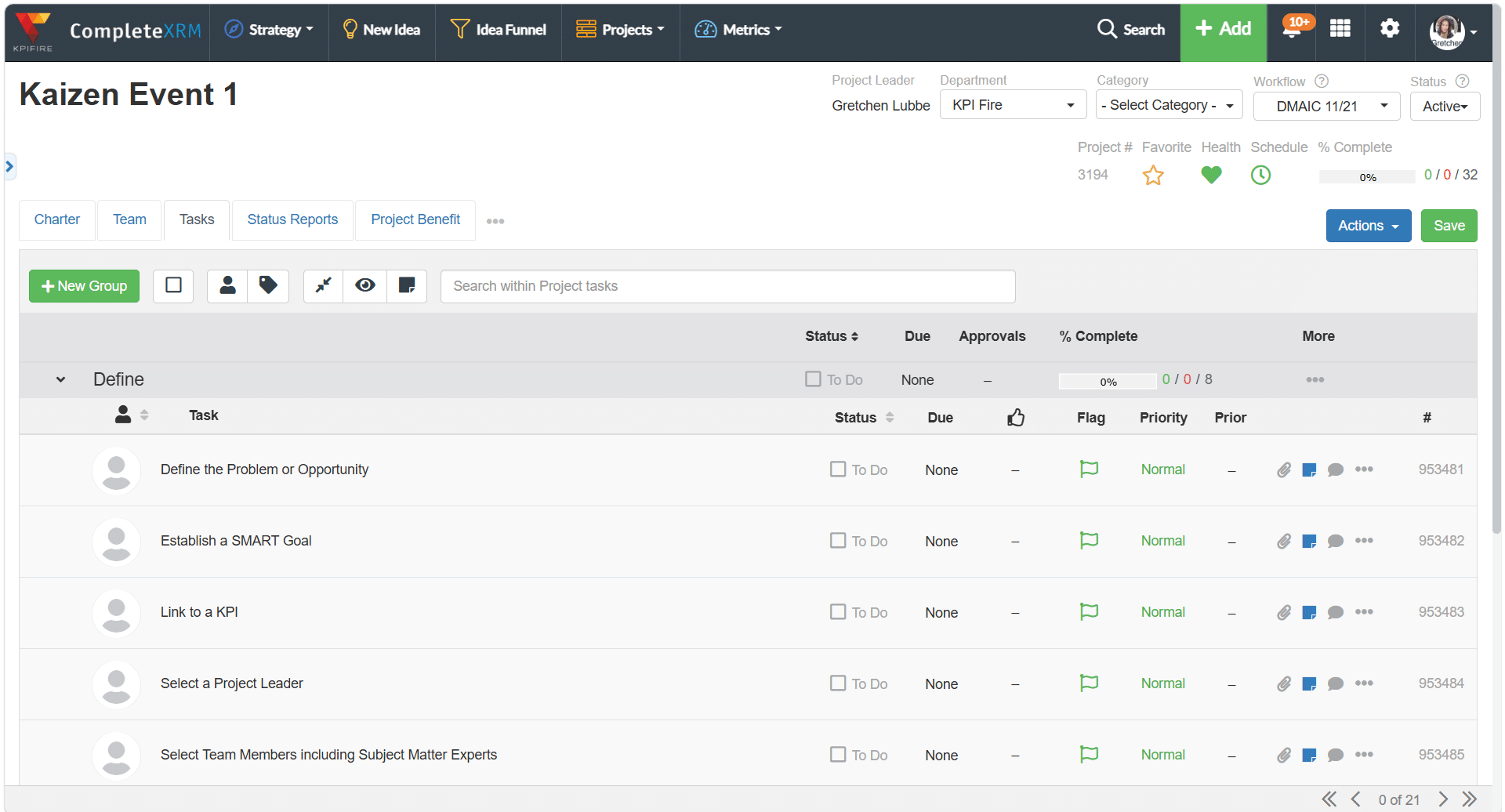
The image below shows the Tasks tab within a project named “Kaizen Event 1” inside KPI Fire strategy execution software.
This specific screen displays the Define phase of a DMAIC (Define, Measure, Analyze, Improve, Control) workflow. It lists foundational tasks like defining the problem, establishing SMART goals, and selecting team members.
To effectively manage a Kaizen event using this platform, follow these steps:
1. Project Creation & Workflow Selection
-
Click the + Add button (top right) and select Project.
-
Name the Event: Give it a clear title (e.g., “Reduction in Shipping Lead Time”).
-
Select Workflow: As seen in the image, a DMAIC or a specific Kaizen workflow should be chosen from the dropdown. This automatically populates the necessary phases and tasks.
2. Define the Charter
-
Navigate to the Charter tab (to the left of the Tasks tab).
-
Document the Problem Statement, Business Case, and In-Scope/Out-of-Scope parameters.
-
Link to a KPI: Use the “Metrics” link to tie this event to a specific global goal (like reducing waste or increasing OEE) so the impact is visible at the executive level.
3. Assemble the Team
-
Go to the Team tab.
-
Assign a Project Leader, Sponsor, and Team Members. In the software, this ensures that everyone assigned receives notifications for their specific tasks.
4. Manage the Task List
-
In the Tasks view (shown in your image), assign Due Dates and Owners to each line item.
-
Establish a SMART Goal: Ensure the goal is specific and measurable within the tool so you can track the “% Complete” bar.
-
Use the “New Group” button if you need to add specific sub-phases, such as “Pre-Work,” “Event Days,” or “Follow-up/Sustain.”
5. Track Benefits and Reporting
-
Project Benefit Tab: Once the event is underway, log the hard or soft savings realized.
-
Status Reports: Use this tab to provide quick updates to stakeholders without them needing to dig into individual tasks.
6. Execution & Visualization
-
Click the Save button frequently as you update task statuses from “To Do” to “Doing” or “Done.”
-
Monitor the Health (heart icon) and Schedule (clock icon) in the top right to ensure the Kaizen event isn’t falling behind.
Using KPI Fire to Continuously Power Kaizen
Without the right infrastructure, Kaizen can easily devolve into “flavor of the month” initiatives that fail to stick. KPI Fire bridges the gap between mindset and method, turning abstract ideas into a high-performance engine for growth.
1. Align Goals: Connect Team Goals to Strategic Objectives
True Kaizen requires that every small improvement moves the needle on a larger company objective. KPI Fire provides a Strategy Cascade that ensures no project exists in a vacuum.
-
Strategic Visibility: Link individual Kaizen bursts or “Just-Do-Its” directly to high-level KPIs like EBITDA, safety ratings, or customer satisfaction.
-
Prioritization: Help teams choose the right problems to solve by identifying which projects offer the highest impact on the organization’s North Star goals.
-
Vertical Transparency: Allow executives to drill down from a global goal to see exactly which local improvements are driving the data.
2. Track Improvements: Use Dashboards to Measure Progress in Real Time
Data is the lifeblood of the PDCA (Plan-Do-Check-Act) cycle. KPI Fire replaces messy spreadsheets with automated, visual data.
-
Real-Time Metrics: View live executive KPI dashboards that update as teams complete tasks, providing an immediate feedback loop on whether an experimental change is working.
-
Benefit Tracking: Automatically calculate the Hard Savings, Soft Savings, and Labor Hours saved from every Kaizen event.
-
Visual Management: Use digital “Bowling Charts” and X-Matrix to see at a glance where projects are on track and where they are stalled.
3. Engage Everyone: Give Every Employee a Voice in Improvement Projects
Kaizen is most effective when it comes from the “Gemba” (the place where work happens). KPI Fire democratizes the improvement process by offering the following features:
-
Idea Funnels: Start activating ideas with this simple interface. Employees can easily submit an improvement idea from their workstation or mobile device.
-
Collaboration Hubs: Use project workflows that allow cross-functional teams to communicate, share files, and update statuses in one centralized location.
-
Empowerment: Shift the culture from “doing what you’re told” to “improving how you work,” enabling employee accountability.
4. Standardize Processes: Document and Share Best Practices Across Teams
The “Standard Work” is the foundation of Kaizen; without it, improvements eventually backslide. KPI Fire acts as the institutional memory of your organization.
-
Workflow Templates: Create standardized project workflows for DMAIC, PDCA, or 5S events to ensure a consistent approach across different departments.
-
Best Practice Library: Store successful project outcomes and “Lessons Learned” in a searchable database, preventing teams from reinventing the wheel.
-
Global Replication: Easily “copy and paste” a successful improvement from one plant or office to another with a single click.
5. Celebrate Success: Highlight Wins to Keep Motivation High
Continuous improvement is a marathon, not a sprint. KPI Fire helps you maintain momentum by making success visible.
-
Recognition Features: Use the platform to shout out top contributors and teams who have exceeded their improvement targets.
-
Impact Reports: Generate professional reports that showcase the cumulative value of Kaizen efforts to stakeholders and board members.
-
Gamification: Create friendly competition between departments by tracking “Participation Rates” and “Project Completion” streaks to keep energy levels high.
By integrating these five pillars, KPI Fire turns Kaizen from a mere philosophy into a practical, repeatable system. It helps leaders and teams stop just talking about continuous improvement and start living it every day.
Kaizen in Motion: Your Next Step
Kaizen isn’t just a philosophy—it’s a practice. The true power of continuous improvement lies in taking small, intentional steps every day that compound into extraordinary results. For KPI Fire, embracing Kaizen means embedding improvement into the DNA of your culture, where every team member feels empowered to spark change, experiment, and evolve. The next step is simple yet profound: start small, stay consistent, and let progress build momentum.
When you commit to Kaizen, you don’t just improve your KPIs—you ignite a fire of growth that transforms your organization from the inside out. Let’s spark continuous improvement together. Request your demo today to transform a scattered set of projects and ideas into a disciplined, measurable, and highly profitable Strategy Execution System.