It could be said that most corporate “teams” are simply groups of individuals tethered to the same platform, sharing the same status meetings, and accidentally overlapping on the same spreadsheets. But what if the chaos of a new project wasn’t a sign of failure, but a biological necessity for success? Understanding Tuckman’s 5 stages of team development isn’t about HR theory; it’s about mastering the mechanics of human momentum.
Whether you are launching a global Lean initiative or scaling a local Scrum team, you are not just managing tasks—you are navigating a predictable evolution of human behavior. This guide is your roadmap to identifying where your team is currently sitting and, more importantly, how to catapult them into a state of high-velocity execution. Welcome to the laboratory of high performance; let’s look at how to build an engine that actually delivers.
1. The Forming Trap
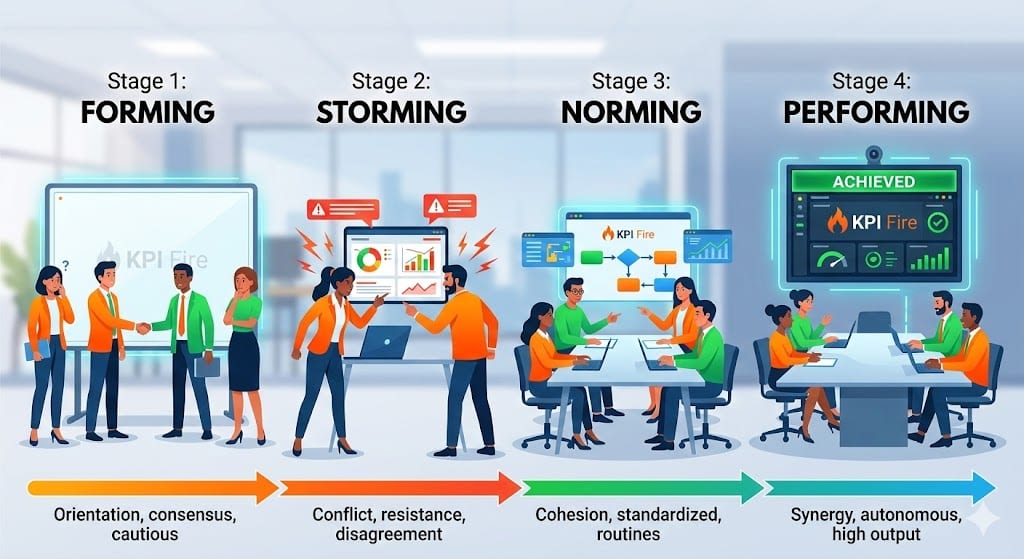
In the earliest hours of a project, the atmosphere is deceptively calm. This is the Forming stage. On the surface, it looks like alignment: people are nodding, the kickoff deck is polished, and everyone is being remarkably polite. But for a seasoned leader, this “honeymoon phase” should be a red flag.
During Forming, team members are operating from a place of psychological safety-seeking. They are testing the waters, trying to figure out the unspoken power dynamics, and—most dangerously—waiting for instructions. In a “Forming” environment, the gap between high-level vision and daily execution is at its widest because no one wants to be the first to point out that the roadmap is blurry.
The Hidden Cost of the Honeymoon
When a team stays in the Forming stage for too long, they burn through the most valuable resource of any project: initial momentum. Because no one wants to “rock the boat,” critical questions about resource allocation, technical debt, or unrealistic deadlines go unasked. The result? A project that starts with a smile but ends with a scramble.
Actionable Moves:
-
Architect the Rules of Engagement: Don’t wait for “natural” culture to form. Explicitly define how decisions are made, how conflict is escalated, and how work is handed off.
-
Pin the KPI to the Person: Use a KPI management platform to move beyond “Group Goals.” If everyone owns the metric, no one owns the metric. Assign clear, verifiable ownership to specific project milestones immediately. This step also contributes to establishing team accountability.
-
Role Clarity: Assign “Project Owners” and “Task Owners” within the platform. When everyone can see exactly who is responsible for which metric, you eliminate the “waiting for instructions” phase.
-
Strategy Alignment: Use a Balanced Scorecard module to link the team’s new project directly to high-level company goals. This gives the team an immediate sense of purpose and helps to establish strategic alignment.
-
Force the First Friction: Ask a “Hard Truth” question in the first week. Challenge a deadline or a resource constraint publicly to show the team that critical thinking is valued over consensus.
-
Project Kickoff: Use Project Charters to document “Rules of Engagement” so they are accessible 24/7.
2. Storming: Turning Friction into Strategic Fuel
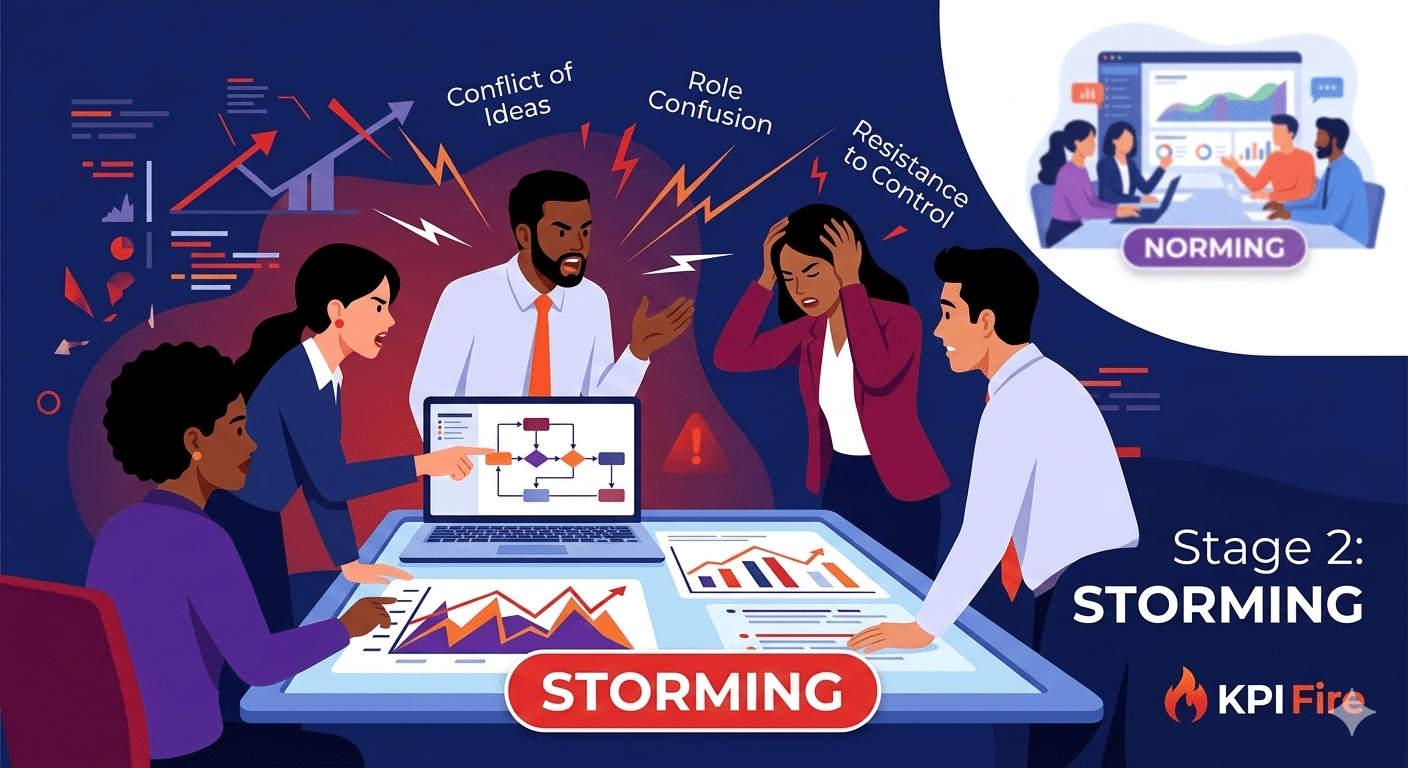
If you feel like your project is falling apart, congratulations—you’ve likely reached the Storming stage. This is the phase where the polite masks slip, the reality of the workload hits, and team members begin to clash over “how” things should get done.
In many organizations, leadership reacts to Storming by trying to suppress it. They call for more “team building” or try to smooth over the cracks. This is a strategic mistake. Storming is the process by which a team stress-tests its own systems. It is the friction required to generate heat. If you suppress the storm, you end up with a team that is “harmonious” but ultimately mediocre.
Diagnosing the Source of the Friction
Ninety percent of “interpersonal” conflict in a project is actually Systemic Conflict in disguise. When two team members argue over a hand-off, they aren’t usually mad at each other; they are mad at a broken process that lacks clarity. As a leader, your job is to listen to the storm to find the cracks in the infrastructure.
Actionable Moves:
-
Conduct a Process Audit: When tensions rise, stop the meeting and map the workflow. Use a visual management tool like KPI Fire to see exactly where the bottleneck lives. Usually, the “villain” isn’t a person; it’s a redundant approval step or a vague requirement.
-
The “Five Whys” of Conflict: When a team member pushes back, don’t defend the plan—ask why. Dig deep with the 5 Whys until you find the structural reason for the resistance.
-
Redirect Energy to the North Star: When the team is fighting, they have lost sight of the “Why.” Re-anchor the conversation to your primary KPIs for growth. Conflict is healthy when it’s about how to win; it’s toxic when it’s about who is right.
3. The Norming Blueprint: Standardizing the Flow State
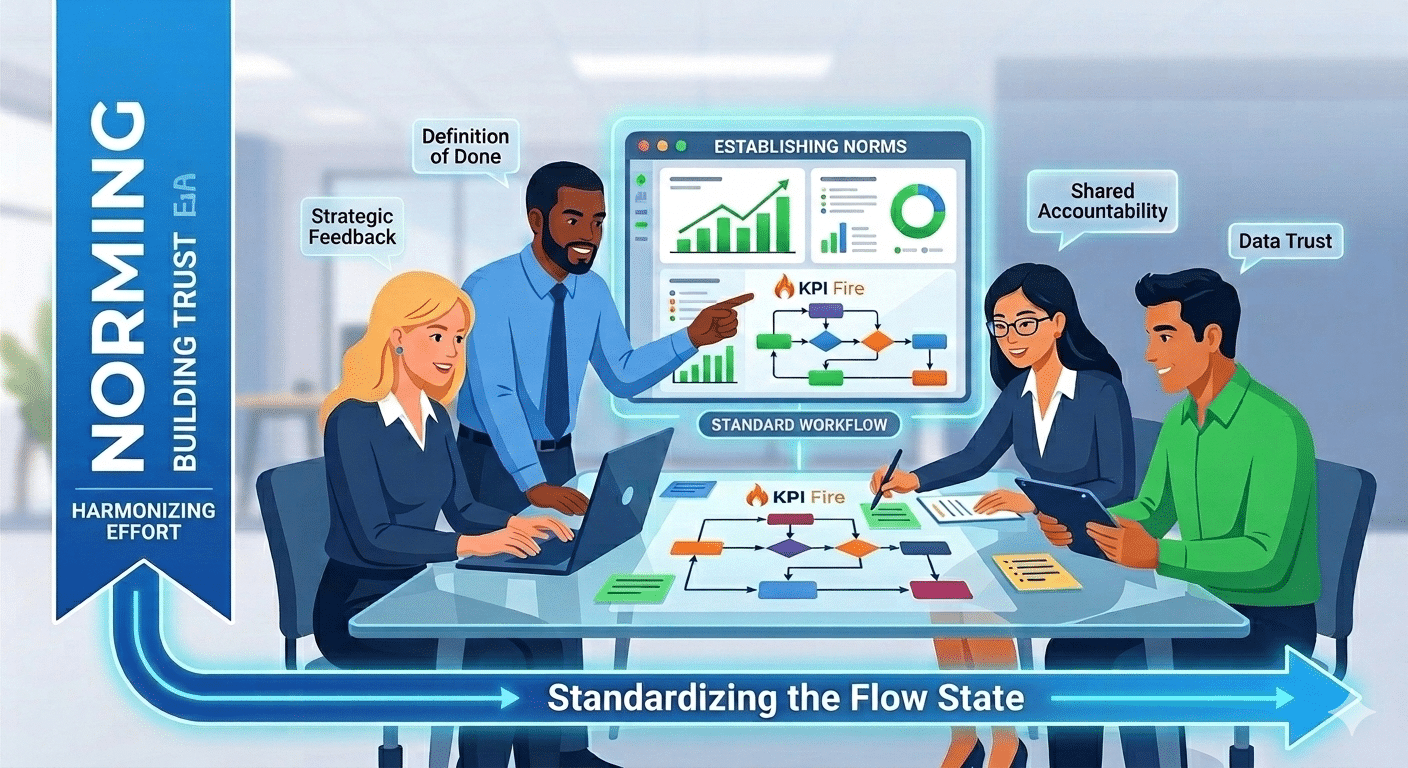
Once the storm subsides, you enter Norming. The team has survived the friction, the power struggles have been resolved, and a “rhythm” is beginning to emerge. This is where the team starts to develop its own shorthand and internal culture.
The danger here is complacency. In the Norming stage, teams often settle for a “good enough” pace. They have found a way to coexist, but they haven’t yet found a way to dominate. If you don’t institutionalize the lessons learned during the storm, you will drift back into mediocrity the moment a new challenge arises.
From Accidental Rhythm to Intentional Standards
High-performance teams don’t just “have” norms; they architect them. They take the successful workarounds discovered during the Storming phase and turn them into Standard Work. They move from “this is how we’re doing it today” to “this is the gold standard for how this task is executed.”
Actionable Moves for the Norming Stage:
-
Create a Playbook: Document the successful workflows that emerged from the chaos. If a specific communication cadence worked, make it the standard for all future sprints.
-
Peer-to-Peer Accountability: In Norming, the leader should step back and rely on team accountability. If a team member misses a deadline, the team should be the first to notice and address it, not the manager.
-
Visual Management: Make the “Norms” visible. Whether it’s a shared KPI dashboard showing real-time progress or a shared “Definition of Done,” ensure the standards are undeniable and accessible.
- Standard Work Templates: Once a process is proven, save it as a Project Template. This ensures that “Norms” are baked into the software for every future sprint.
- Definition of Done: Clearly define the “End State” for every project milestone so the team has a shared standard of excellence.
- Collaborative Huddles: Use Tiered Meeting features (Tier 1/Tier 2 boards) to run daily huddles directly from the KPI Software platform.
4. Strategic Synchronization: Reaching the Peak of Performing
This is the holy grail of team development: the Performing stage. At this level, the team operates as a single, synchronized unit. They no longer need a play-by-play from leadership because they are perfectly aligned with the strategic intent.
In the Performing stage, the gap between “Strategy” and “Task” has completely closed. Every hour spent by the team is a direct deposit into the company’s highest-level goals. This is the “Flow” state of the organization—where velocity is high, friction is low, and the ROI is compounding.
The Leader as a Path-Clearer
Your role in the Performing stage changes dramatically. You are no longer an “orchestrator”; you are a “path-clearer.” If your team is at peak performance, the biggest threat to their success is external interference. Your job is to protect their focus and ensure they have the resources to maintain their pace.
Actionable Moves for the Performing Stage:
-
Aggressive Autonomy: Give the team more control over their “How.” If they are hitting their KPIs with precision, step out of the tactical meetings entirely.
-
Monitor the Burnout: Performing teams are high-rev engines. They can overheat. Monitor the “internal” KPIs—morale, overtime, and stress levels—to ensure the pace is sustainable.
-
Upstream Planning: Since the team is handling the “now” with ease, use your time to look 6–12 months ahead. Start preparing the next strategic vision with an X-Matrix so that when this project concludes, the transition is seamless.
5. The Adjourning ROI Most Leaders Ignore
Most projects end with a whimper: a final email is sent, comms go quiet, and everyone is immediately reassigned to the next fire. This is a massive loss of Intellectual Capital. Tuckman’s final stage, Adjourning, is the most overlooked phase of team development.
The real value of a project isn’t just the final deliverable; it’s the refined capability of the people involved. If you don’t intentionally “close the loop,” you lose the chance to turn a single win into a repeatable organizational habit.
Securing the Institutional Memory
The Adjourning phase is where you harvest the data. What did we learn? Where did we fail? What “Norms” should we export to the rest of the company? If you can capture the “magic” of a high-performing team and bake it into your company’s DNA, you have achieved more than just a project win—you have achieved a cultural upgrade.
Actionable Moves for the Adjourning Stage:
-
The High-Impact Post-Mortem: Don’t just list what went wrong. Ask: “What did we do when we were at our best, and how do we make that a requirement for the next team?”
-
Template Your Success: Take the workflows, project structures, and reporting cadences that worked and turn them into repeatable project templates. Ensure the next team doesn’t have to start from “Forming” with a blank slate.
-
Recognize the “Behaviors,” Not Just the “Results”: When you reward the team, don’t just talk about the ROI. Talk about the way they collaborated, the way they handled conflict in the storm, and the way they maintained standards. Reinforce the continuous improvement culture you want to see replicated.
The Bottom Line: Don’t Manage People, Manage the Process of Becoming
Tuckman’s stages are a cycle, not a straight line. Every time a new member joins or a strategic pivot occurs, the team might slip back into Storming or Forming. This isn’t a setback; it’s a recalibration.
The most successful leaders are those who don’t fight the evolution of their teams. They embrace the silence of Forming, the heat of Storming, the structure of Norming, and the velocity of Performing. By using a centralized platform – or single source of truth to maintain visibility throughout this journey, you ensure that no matter what stage the team is in, they are always anchored to the goals that matter most.
Request a demo of KPI Fire today to see how it provides the structure, visibility, and accountability needed to move your team through Tuckman’s stages and into peak performance.